What do you need to study if you want to work in space?
Engineering?
Physics?
Rocket science?
Those are certainly some of the answers.
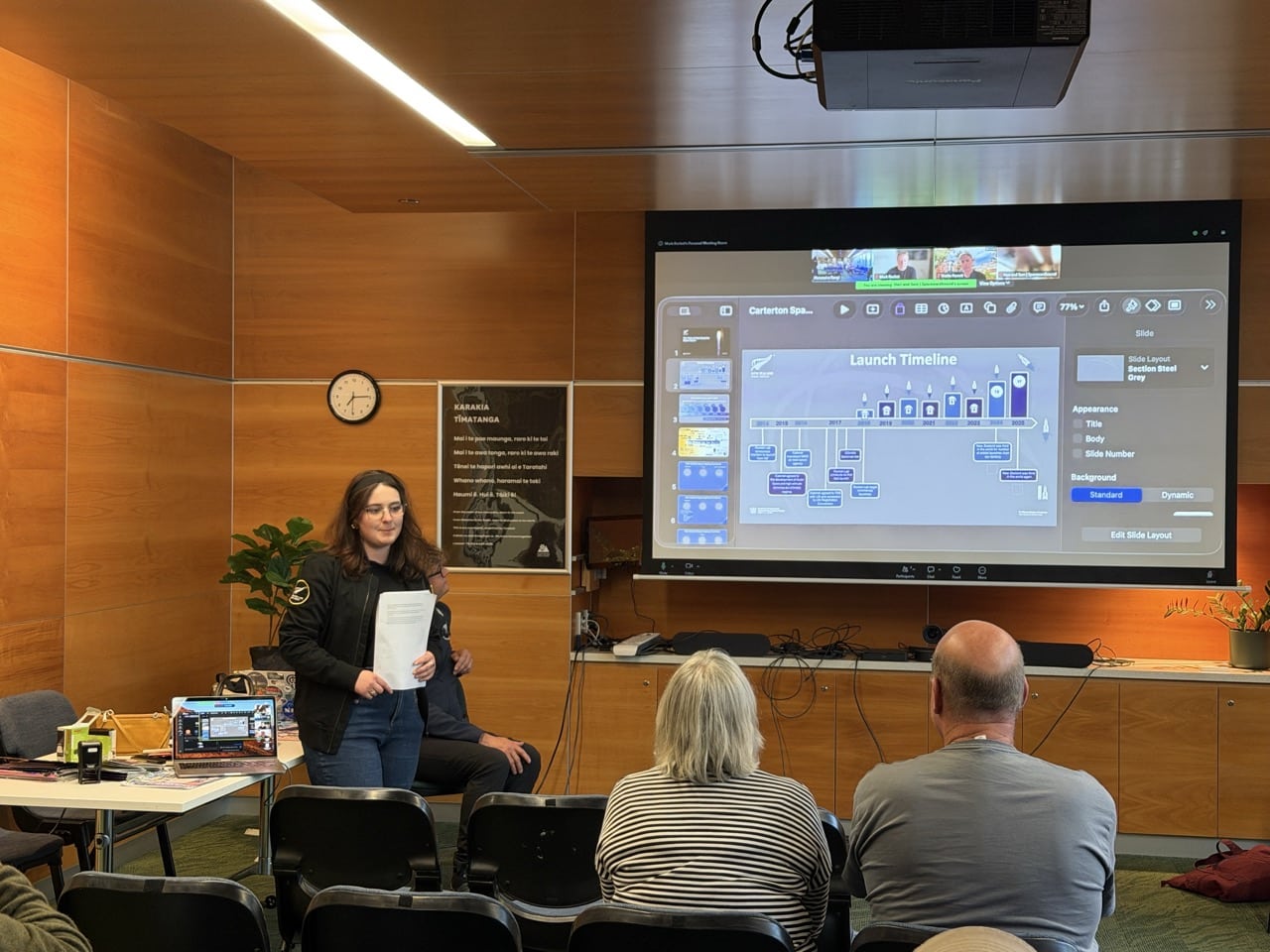
But at Fresh From Space, a Carterton Space Week conversation with people working across New Zealand’s space sector, one message came through again and again:
There isn’t one pathway into space.
The panel brought together Mark Rocket, Dr Yvette Perrott from Te Herenga Waka Victoria University of Wellington, Grace Andrews and TJ Ariu from the New Zealand Space Agency, with astrophysicist Sam Leske moderating. Between them, they work across aerospace, astronomy, research, education, policy and regulation. Mark has even travelled to space himself.
Then someone in the audience asked a question on behalf of a teenager:
What advice would you give a young person who wants to work in the space industry?
The answers are worth sharing with every student who has ever looked upward and wondered whether there might be a place for them.
Build things. Try things. Follow things that interest you.
Mark Rocket works at Kea Aerospace, developing solar-powered aircraft designed to operate for long periods in the stratosphere. For students interested in engineering, his advice was practical. Companies are interested not only in qualifications but in evidence that someone genuinely enjoys solving problems. That might mean building something on the weekend, experimenting with electronics, programming, making a model rocket, entering a competition or pursuing a project simply because you want to know whether you can make it work. Those projects become evidence of curiosity, persistence and developing expertise.
Mark’s advice was:
“Follow your passion and do something that really interests you.”
But what if maths and physics aren’t your thing?
Grace Andrews grew up on a farm under a dark sky. She and her father would go outside stargazing on clear nights, and when her family eventually moved away from the farm, losing that easy access to the stars was one of the things she missed most. She loved space. But she didn’t see herself as a physicist or mathematician. For a while, she thought that meant space wasn’t a career available to her. Then university showed her something important.
Space also needs policy, politics and law.
Today she works for the New Zealand Space Agency.
“I sort of gave up for a little bit, but my dreams caught me in the end.”
Her message to students was that there are hundreds of ways to become involved.
A space mission needs much more than engineers
Dr Yvette Perrott helped establish the Space Science programme at Te Herenga Waka Victoria University of Wellington. The programme deliberately introduces students to different parts of the space sector and allows them to combine space science with other subjects. Why? Because real space missions are interdisciplinary. Imagine that your team wants to build and launch a small satellite. Yes, somebody has to understand its engineering.
But who manages the project?
Who purchases the components?
Who understands the supply chain?
Who writes software?
Who finds sponsors?
Who communicates the mission?
Who understands the regulations governing what you are allowed to launch?
Who analyses the data after the satellite begins operating?
Who works out whether the mission is environmentally and ethically responsible?
As Yvette explained, successful missions require people with a wide range of skills. Students can combine space with physics and engineering, as well as biology, policy and other disciplines. She even described a student interested in combining space and fashion design. At first, that might sound unusual. Then remember: somebody has to design what humans wear in space.
Space isn’t only about rockets
Another important idea from the evening was that the space industry itself is changing. Rockets receive a lot of attention because launches are spectacular. But the New Zealand Space Agency described a much larger ecosystem including manufacturing, GPS and navigation, telecommunications, environmental monitoring, emergency management and advanced aviation.
One particularly important area is known as downstream applications.
That means taking information collected by satellites and turning it into something useful on Earth. Satellite observations can help us understand crops, forests, oceans, weather, environmental change and natural disasters. So somebody working with satellite information for agriculture or environmental management can be working in the space sector without ever building a spacecraft. The panel expects this part of New Zealand’s space economy to grow significantly.
Should we send people, or robots?
The discussion also tackled one of the classic questions in space exploration. Should humans go to Mars and beyond? Human spaceflight presents enormous challenges. Astronauts travelling to Mars would face long periods of radiation exposure, and Mars lacks the protection Earth’s atmosphere and magnetic field give us. Keeping people alive also means transporting or producing food, water, oxygen and shelter. Robots don’t need any of those things.
Yvette argued that robotic spacecraft could allow us to explore scientifically fascinating destinations much farther away, including icy moons such as Europa and Enceladus. Mark pointed to the legacy of New Zealand-born Sir William Pickering and the extraordinary achievements of robotic planetary exploration. That doesn’t mean humans will stop exploring. Instead, it gives us a useful scientific question:
When is a human the best explorer, and when is a robot better?
Space also needs rules
There is another career area students don’t always associate with space at all. Someone has to decide what we are allowed to do up there. Who is that someone? Is it someone in the cloud, or someone like you and us? As more satellites are launched, useful regions around Earth are becoming increasingly congested. Space debris, large satellite constellations and competition for orbital environments create scientific, engineering, political and ethical problems.
The New Zealand Space Agency works across regulation, policy and sector development, including international discussions about how space should be used. That means the future space workforce doesn’t only need people capable of reaching space. It needs people capable of asking:
What should we do once we get there?
Follow your curiosity
TJ Ariu from the New Zealand Space Agency offered perhaps the simplest career advice of the evening:
“Find the thing that you’re really curious about and follow your curiosity.”
That’s useful advice whether you are 12, 17 or already wondering whether you chose the “wrong” subjects. Space isn’t one profession. It is a place where hundreds of professions meet. You might enter through engineering. Or biology. Or computer science. Or astronomy. Or law. Or environmental science. Or design. Or communications. Or policy. Or something that doesn’t have a name yet.
Because the New Zealand space sector that today’s students eventually enter won’t look exactly like the one that exists now. And perhaps that’s the most exciting part.